
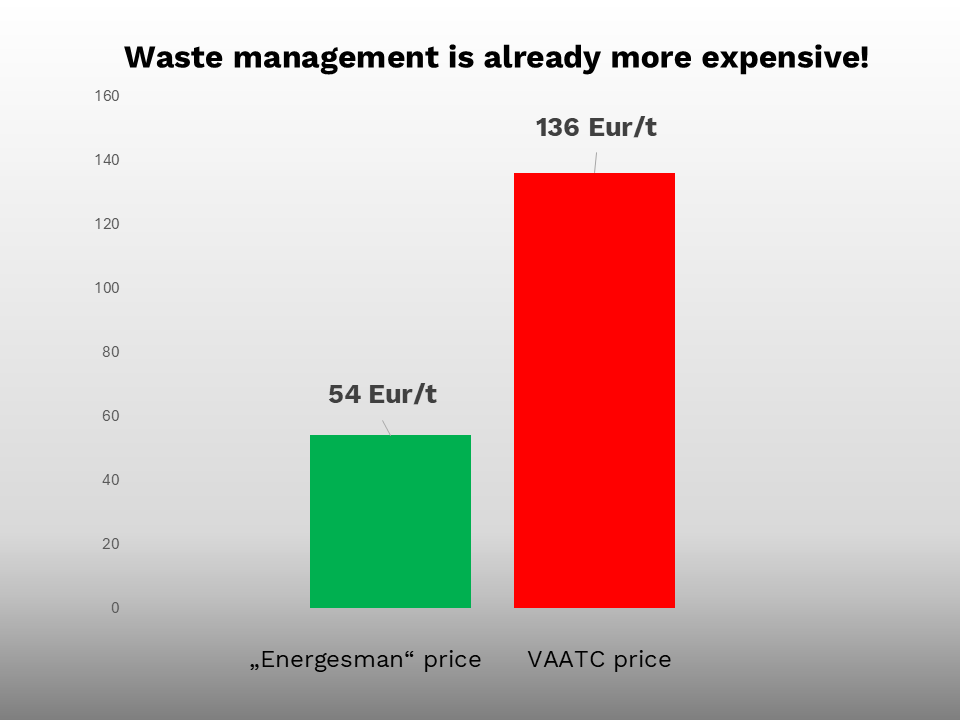
The independent civic public procurement analysis initiative “Viešpirkiai” has published waste management contracts concluded by VAATC with Ecoservice, Ekonovus, and the Vilnius Combined Heat and Power Plant. The price amounts to EUR 135.8 per tonne (excluding VAT) for waste treatment and incineration. If such prices continue to be paid, annual waste management costs for residents will increase by approximately EUR 18 million.
VAATC misled the public about contract negotiations
The price currently paid by VAATC for waste management is nearly three times higher than the price previously paid to Energesman, which managed waste for EUR 53.81 per tonne excluding VAT, including incineration. Approximately 220,000 tonnes of waste are generated annually in the Vilnius region.
The contracts were concluded on 16–17 July. Since then, VAATC has deliberately avoided disclosing the prices and publicly claimed that the contracts were still under negotiation.
“We are witnessing yet another false statement by VAATC – one of many. This is a desperate attempt to justify an artificially created waste crisis. It is evident that these actions are not in the interests of residents, because waste management costs are increasing. It is only a matter of time before these higher costs appear in residents’ utility bills,” says Algirdas Blazgys, CEO of Energesman.
VAATC concluded separate contracts for waste treatment and waste incineration. It committed to pay EUR 62.8 per tonne (excluding VAT) to Ecoservice and EUR 77 per tonne (excluding VAT) to Ekonovus for waste treatment.
An additional EUR 73 per tonne (excluding VAT) will be paid to the Vilnius Combined Heat and Power Plant for waste incineration.
When waste is treated by Ecoservice, the total cost of waste treatment and incineration reaches EUR 135.8 per tonne (excluding VAT) (EUR 62.8 + EUR 73).
The publicly accessible website viespirkiai.org also lists additional contracts concluded by VAATC for the rental of loaders, screeners and lifting equipment, waste transportation, security services, and cleaning services. The total value of contracts concluded during July has already reached EUR 10.58 million.
“VAATC has already committed to paying these millions to suppliers – and this is residents’ money. None of these expenses would have arisen if VAATC had complied with the signed settlement and modernization agreements and had not artificially created this crisis,” Blazgys emphasizes.
VAATC is misleading the public
VAATC’s public claims that 30,000 or even 40,000 tonnes of waste have accumulated on the plant site do not correspond to official data.
On 23 July, the GPAIS waste accounting system recorded 18,800 tonnes of waste. Last week, specialists from the Environmental Protection Department visited the plant and confirmed by drone inspection that approximately 20,000 tonnes of waste were present at the facility.
VAATC unlawfully took over the plant on 24 July. Until that date, Energesman continued to process waste and deliver it for energy recovery. Exact daily quantities of accepted and incinerated waste were reported to the National Crisis Management Centre.
“VAATC is deliberately misleading and frightening the public in order to justify its takeover of waste management operations and, according to information made public, to redirect waste flows to interested business groups,” says Dr. Paulius Miliauskas, partner at the law firm Miliauskas ir Lauraitytė.
According to the lawyer, there are reasonable grounds to question whether Marius Švaikauskas is properly performing his duties as head of VAATC.
“He is undermining the MBA plant modernization project that is important to the residents of the Vilnius region and, within a very short time since taking office at VAATC, is committing enormous amounts of money that belong to the region’s residents. Under the law, the activities of the head are supervised by the VAATC Board. The question arises whether the Board is properly performing its duties if funds are being spent recklessly right under its nose. The Board is obliged to act in the interests of all residents of the region,” Miliauskas notes.
As blogger Skirmantas Malinauskas publicly stated on Sunday, a redistribution of the waste market is currently taking place. Competitors are in a particularly favorable position to take over the plant because all preparatory work for rebuilding the new waste sorting facility has already been completed.
Calculation
EUR 135.8 − EUR 53.81 = EUR 81.99 additional cost per tonne
EUR 81.99 × 220,000 tonnes = EUR 18.04 million per year