
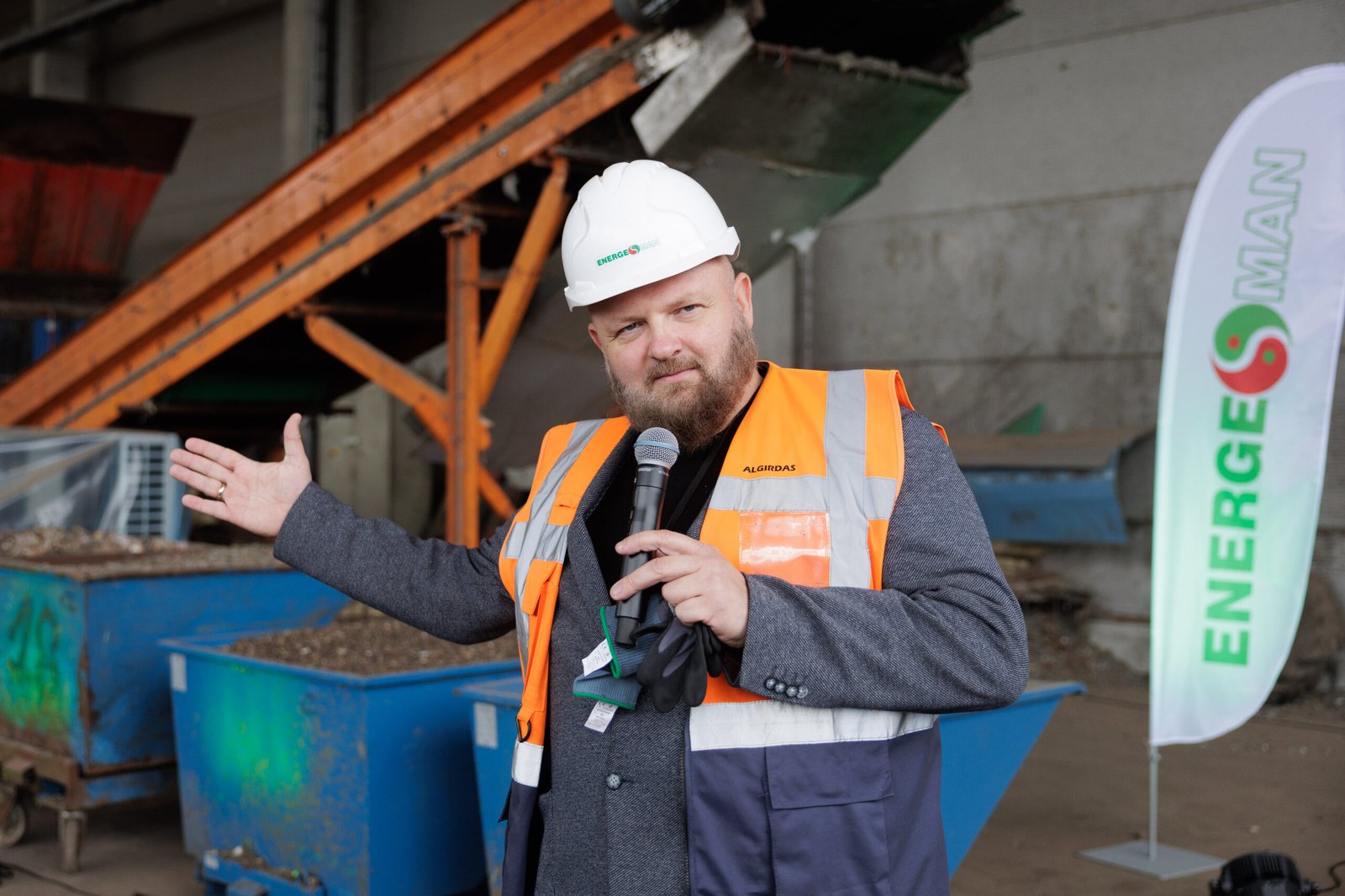
Mixed municipal waste continues to be delivered to the Vilnius Regional Mixed Waste Sorting Plant, where it is being received and processed by our employees. Under the operating agreement, UAB “VAATC” was required to provide 20 business days’ prior notice before terminating the contract. It failed to do so. According to preliminary estimates, the disruption caused in the waste management sector will result in losses exceeding EUR 50 million, costs that will ultimately be borne by residents.
Waste reception continues
“Waste has continued to be delivered to the plant throughout the weekend and today, and our employees remain at work,” says Algirdas Blazgys, CEO of our company.
During the weekend, bailiffs visited the facility to document the ongoing waste reception and the current situation. They were invited both by us and by VAATC.
Waste reception and treatment continue uninterrupted. Approximately 30 employees work in each shift, with operations running in two shifts every day. Waste is accepted daily from 6:00 a.m. until 11:00 p.m.
VAATC failed to comply with the required notice period
Under the plant operating agreement, VAATC was obliged to provide 20 business days’ notice before terminating the contract unilaterally. During that period, the operator should have been given an opportunity to remedy any alleged deficiencies.
“We never received any notice of the intended contract termination,” emphasises A. Blazgys.
On the contrary, VAATC formally accepted the services we provided in both May and June as satisfactory. Invoices were issued for these services in accordance with the agreed acceptance and delivery acts.
“However, VAATC has still not paid for the services we provided in June, while payment for May services has only been made partially, despite the Lithuanian Law on Public Procurement requiring contracting authorities to settle invoices within no more than 30 days,” says A. Blazgys.
As of 13 July, VAATC still owed EUR 220,000 for services provided in May, although payment was due by 30 June.
VAATC also failed to fulfil its obligations under the signed plant modernisation agreement by failing to pay EUR 4.4 million by 26 June, funds intended as advance payments to equipment manufacturers.
The damage will affect both the region and Lithuania
Preliminary estimates indicate that the disruption caused by VAATC will cost residents of the Vilnius region more than EUR 50 million.
Currently, we process mixed municipal waste at EUR 53.81 per tonne (excluding VAT), whereas other waste treatment providers charge approximately EUR 120 per tonne (excluding VAT). Based on an annual volume of 220,000 tonnes, the cost of waste treatment in the Vilnius region will increase by EUR 14.56 million.
Waste-to-energy costs will also increase. We currently pay EUR 32.50 per tonne for waste incineration at the Vilnius Combined Heat and Power Plant. If VAATC assumes the contract, the price regulated by the National Energy Regulatory Council (VERT) of EUR 48.80 per tonne would apply. With approximately 125,000 tonnes incinerated annually, this would add EUR 2.04 million in yearly costs.
The planned modernisation of the plant will become EUR 15 million more expensive because the already approved European Union funding and our commitment to finance the investment during the remaining operating period will no longer apply.
Food waste treatment costs will also rise significantly. We currently process food waste for EUR 15 per tonne, while residents in the Kaunas region pay EUR 138.62 per tonne. Processing approximately 12,000 tonnes of food waste annually would therefore cost an additional EUR 1.48 million each year.
Our company is the only certified producer of Solid Recovered Fuel (SRF) in Lithuania, supplying SRF produced from waste to AB Akmenės cementas.
“Both the certification and the supply contract belong to us, not to VAATC,” notes A. Blazgys.
Without our operations, the waste required for SRF production would instead be disposed of in landfill, generating an additional EUR 2.1 million in annual costs.
This would also worsen air quality for residents living near the Kazokiškės landfill and negatively affect Lithuania’s environmental performance, potentially exposing the country to penalties from the European Commission.
Recycling rates for textiles and plastics would also decline, as our company is currently developing new technologies for recycling these waste streams.
The decision took less than an hour
“Based on our correspondence with VAATC, we can see that Friday’s VAATC Board meeting lasted less than an hour. The termination grounds sent to us were purely formal and lacked any specific justification. We asked to attend the meeting and present our position, but this request was rejected. Can a decision with such significant consequences for Lithuania’s entire waste management system really be made without discussion or proper assessment?” asks A. Blazgys.
Until now, any decision within VAATC regarding documents, requests or proposals typically took a considerable amount of time.
The Vilnius City Municipality owns 76.51% of VAATC’s shares, while the remaining shares are held by other municipalities of the Vilnius region.