
The Vilnius Regional Mixed Municipal Waste Sorting Facility, operated by our company, continues to accept waste, although at a reduced pace due to the temporary suspension of waste intake by the Vilnius Combined Heat and Power (CHP) Plant. At the same time, the reconstruction of the facility and the installation of a new sorting line have been placed on hold while we continue to seek a constructive solution.
Waste is being accepted and stored
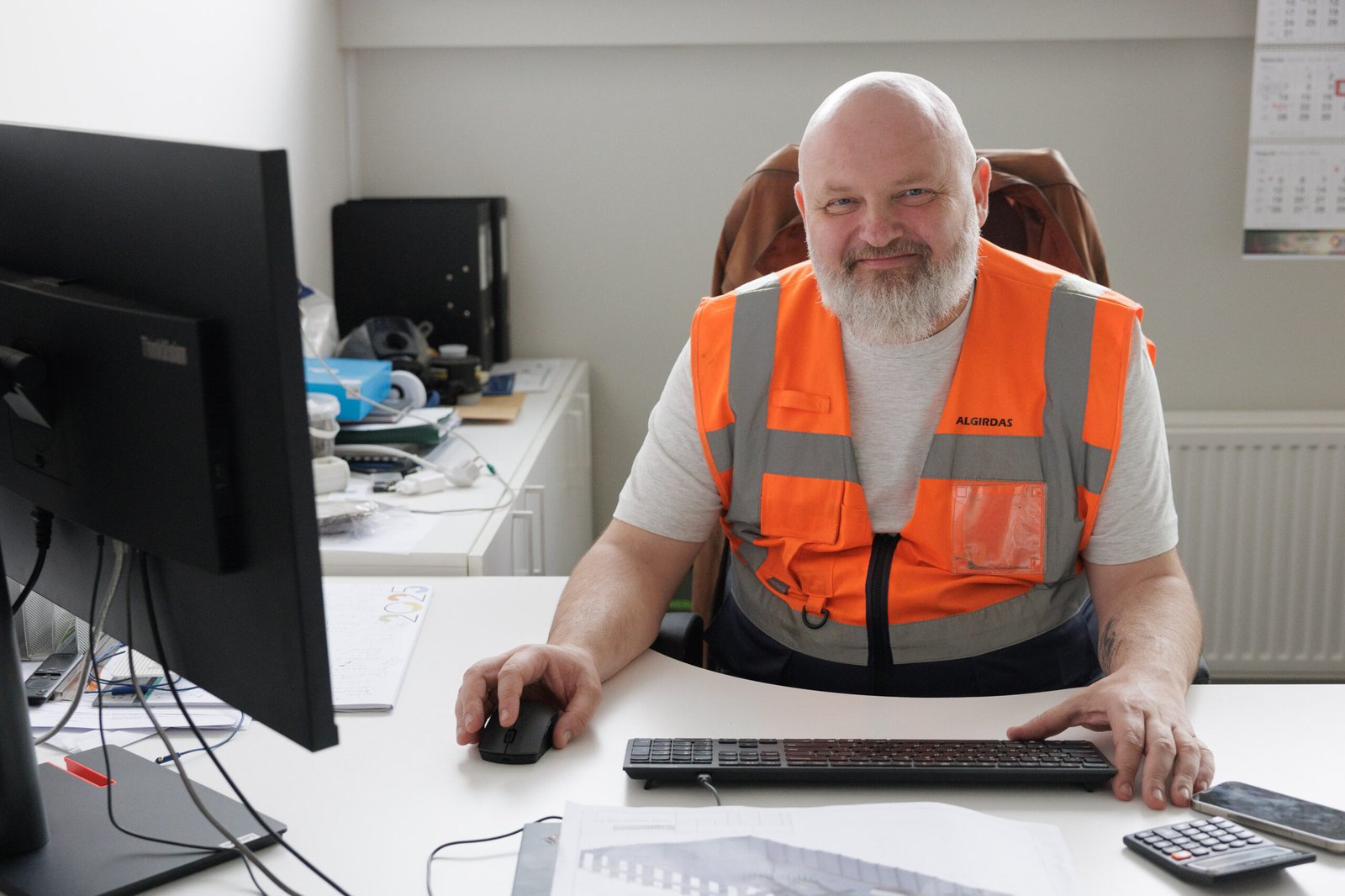
“We are currently accepting six waste collection vehicles per hour. This intake rate has been set by the Emergency Operations Centre, and we are fully complying with this schedule,” says Algirdas Blazgys, CEO of our company.
Waste is being accepted at a reduced pace because, as every summer, the Vilnius CHP Plant has reduced its intake of waste for energy recovery and is currently not accepting any waste from the Vilnius sorting facility.
The sorted waste is being stored within the facility’s premises. The amount of waste currently stored does not exceed the limit of 24,000 tonnes established under the Integrated Pollution Prevention and Control (IPPC) permit.
“The amount of waste stored at our site fully complies with the permitted limits. Therefore, the information circulating publicly is inaccurate,” Blazgys emphasises.
According to Blazgys, residents are also being unnecessarily alarmed about the risk of another fire. The fire that occurred at the facility last spring was not caused by excessive volumes of waste but by an external object that had been discarded alongside the waste and subsequently ignited. This was confirmed by the Fire Investigation Centre.
It should also be noted that, under Lithuanian law, municipalities are responsible for ensuring that residents sort their waste properly and do not dispose of combustible items together with mixed municipal waste.
Reconstruction of the facility has been suspended
“We can resolve the issue of accumulated waste relatively quickly. All that is needed is an agreement with the Vilnius CHP Plant to resume accepting our waste for energy recovery. The greater challenge is rebuilding the facility,” Blazgys says.
In early May, the Vilnius District Court approved a settlement agreement between UAB VAATC, the owner of the sorting facility, and our company as operator. Under the agreement, we committed to investing EUR 10 million in rebuilding a modern waste sorting facility.
By the end of this year, a new robotic sorting line was to be installed and the facility fully reconstructed. This would have become the most advanced mixed municipal waste sorting facility in Lithuania and across the Baltic States, without increasing waste management costs for residents, as the investment would be financed by the private operator.
“However, these investments have now been put on hold. We have formally notified VAATC that it is failing to fulfil its contractual obligations, and we are therefore considering terminating the agreement. Nevertheless, until the very last moment, we remain committed to finding a constructive solution,” says Blazgys.
In December 2025, VAATC launched an international public procurement procedure for the installation of a new waste sorting line as part of the facility’s modernisation. Three bidders submitted proposals.
In April this year, VAATC completed the evaluation of the bids and declared our company, Energesman, the winner after we submitted the lowest bid of EUR 11.75 million. The second bidder offered EUR 15.55 million, while the third bidder proposed EUR 15.74 million.
On 27 May, VAATC and our company signed the public procurement contract under which we committed to designing, manufacturing and installing a modern mixed municipal waste sorting line at the Vilnius MBA facility by the end of this year and transferring ownership of the equipment to VAATC.
Under the contract, VAATC was required to make the first payment of EUR 4.4 million by 26 June to cover advance payments to equipment manufacturers.
“As of today, 10 July, we have not received any payments. We remain in intensive discussions and still hope that a positive agreement can be reached so that the facility can be rebuilt on time. Fourteen months have already passed since the fire, and from a business perspective, it is difficult to understand why the process has taken so long,” Blazgys emphasises.
Residents would face higher waste management costs
If no agreement is reached, the reconstruction of the waste sorting facility would be postponed indefinitely, as the public procurement process would have to be repeated.
Based on the prices submitted by the other bidders, the procurement of new equipment alone would cost at least EUR 4 million more. This would translate into approximately EUR 9.5 per household across the Vilnius region.
“Waste management costs for residents would also increase. According to our calculations, households would pay at least EUR 33.5 more per year. This is because we currently provide waste management services at EUR 53 per tonne, whereas other operators interested in taking over the service are currently charging around EUR 120 per tonne,” Blazgys notes.
Last year, we processed and sorted 202,000 tonnes of mixed municipal waste at the facility. Most of the waste (93%) was recovered: recyclable materials were separated and sent for recycling, solid recovered fuel (SRF) produced from waste was supplied to a cement plant, and the remaining waste was used as fuel at the Vilnius CHP Plant.
The Vilnius MBA facility was built more than ten years ago. It processes municipal waste collected across the entire Vilnius region, which comprises eight municipalities: the City of Vilnius and the district municipalities of Vilnius, Trakai, Elektrėnai, Ukmergė, Švenčionys, Šalčininkai and Širvintos.