
Following the fire at our facility, Energesman has been subjected to dozens of inspections by the Environmental Protection Department and the Fire and Rescue Department. Violations were recorded for even minor issues – for example, for a container temporarily placed outside the fence.
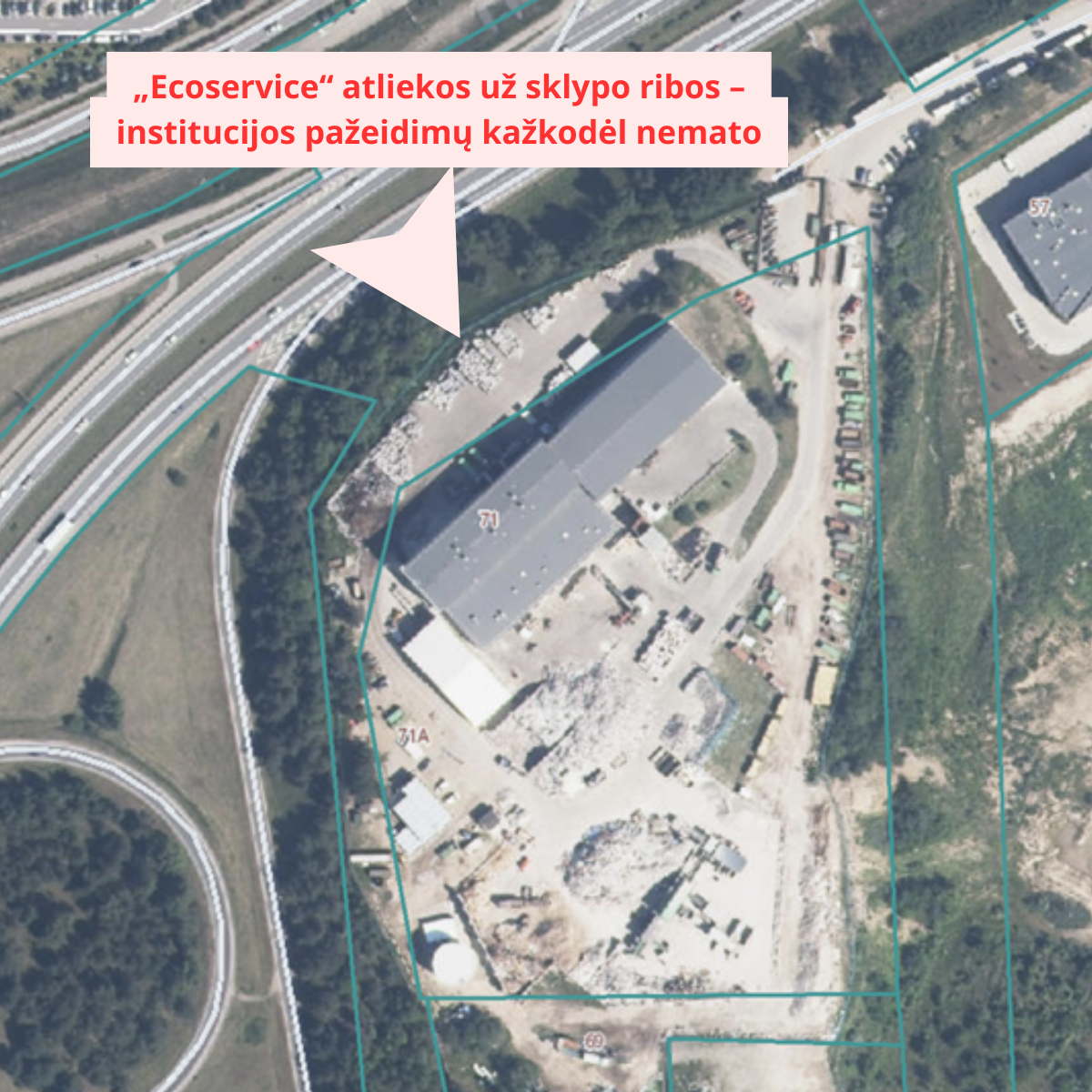
At the same time, institutions failed to identify that competitor Ecoservice was allegedly using 0.7 hectares of state-owned land without legal grounds and storing waste there, while they have also raised no objections regarding Ekonovus, which is processing waste directly on bare ground near the banks of the Vilnelė River.
State-owned land used as private property
“It is difficult not to be astonished by such double standards. A legitimate question arises: whose interests are these institutions serving? In our view, they have played a significant role in what appears to be an unfair competition scheme,” says Algirdas Blazgys, CEO of Energesman.
On Friday, 24 July, it was announced that following an appeal by the Lithuanian Green Party to the State Territorial Planning and Construction Inspectorate, violations had been identified at the Ecoservice waste management facility located at Gariūnų g. 71, Vilnius.
According to the publicly available information, approximately 0.7 hectares of state-owned land had been incorporated into the Ecoservice operating area. The land contains fences, gates, vehicle weighing equipment, waste storage areas, modular containers, stored waste and other infrastructure related to the company’s operations. These elements are visible on the REGIA public mapping system.
“We have not heard that the Environmental Protection Department recorded or publicly announced a violation by Ecoservice for storing waste outside its officially designated facility boundaries. Yet Energesman was cited for temporarily placing several containers with sorted metal waste outside the fence after the fire, while we were making space for equipment needed to dismantle damaged building structures,” Blazgys notes.
The Environmental Protection Department also recorded a violation against Energesman because several plastic bags had been blown by the wind outside the fence after the fire and had not yet been collected by employees.
“Meanwhile, a competitor appears to be allowed to keep waste outside its official territory on a permanent basis without attracting any objections from the authorities. How can that be possible?” Blazgys asks.
Waste processed near the Vilnelė river while institutions remain silent
The Environmental Protection Department has stated that part of Energesman’s waste is stored on a surface that is not impermeable to water, creating a potential risk that leachate and contaminated runoff could enter the soil.
On 17 July, the Department issued a public statement to that effect even though the inspection procedure had not yet been completed and the alleged violation had not been officially confirmed. Nevertheless, this preliminary assessment was subsequently relied upon by VAATC and the Vilnius City Municipality when taking over Energesman’s operations.
Energesman emphasises that the entire Vilnius MBA site is equipped with a contaminated water collection system designed to prevent water from entering the ground.
At the same time, the Environmental Protection Department has not publicly identified any violations concerning Ekonovus, where piles of unsorted waste are reportedly stored directly on bare ground.
Images circulated on Facebook last week showing waste allegedly being processed on open ground without a hard surface at a site operated by Ekonovus in Naujoji Vilnia, Pramonės g. 141, Vilnius. The Vilnelė River flows only a short distance from the site.
Residents’ video footage here.
“Rain falls directly onto the waste, runoff may reach the Vilnelė River and seep into the ground, yet we hear no public response from the responsible institutions,” Blazgys says. “Residents tagged the Vilnius City Municipality, the Mayor and state institutions in the published footage, so it is difficult to believe that the situation went unnoticed.”
Unscheduled inspection conducted days before the takeover
Under the rules approved by the Fire and Rescue Department, waste must be stored at least 15 metres away from buildings.
“If we expanded our site onto state-owned land as our competitors appear to have done, we could easily comply with that requirement. Instead, we acted lawfully and already in 2024 asked VAATC and the Vilnius City Municipality to form an additional land plot for the Vilnius MBA facility because the existing site is too small to meet the firefighters’ requirements. No additional plot has been allocated to this day,” Blazgys says.
On 8 July, officers of the Vilnius Fire and Rescue Board carried out an unscheduled inspection at the Energesman site and recorded a violation for storing waste less than 15 metres from buildings.
VAATC and the Vilnius City Municipality later relied on this finding when announcing the termination of the operating agreement on 10 July and when subsequently filing a court claim.
“The timing is striking. Why was there a sudden need for another inspection on 8 July? If the same standards had been applied to competitors, violations related to the use of state-owned land and waste storage outside authorised plots should also have been identified,” Blazgys says.
As blogger Skirmantas Malinauskas stated publicly on Sunday, the current developments may be linked to a broader redistribution of the waste management market. In his view, competitors now have a strong commercial incentive to take over the facility because the preparatory work for rebuilding and modernising a new waste sorting plant has already been completed.